Clinical trials sound intimidating. They aren’t. At their core, clinical trials are research studies involving people. They test new ways to prevent, detect, or treat disease. That includes new drugs, new combinations of treatments, new approaches to care, and sometimes new ways of using treatments we already have.
Every treatment used for breast cancer today exists because someone participated in a clinical trial. There’s no shortcut around that truth.
Clinical trials are not experiments done on people. They are studies done with people, under strict rules designed to protect participants.
What Happens in a Clinical Trial
A clinical trial follows a protocol. That’s a detailed plan explaining what will happen, who can join, and how safety is monitored. Participants are informed of risks and benefits before agreeing to take part. That’s called informed consent. You can ask questions. You can say no. You can leave at any time.
Some trials compare a new treatment to the current standard of care. Others test supportive therapies like managing side effects, fatigue, or emotional well-being. Not all trials involve new drugs. Many involve better ways to live and heal.
Why Clinical Trials Matter for Black Women
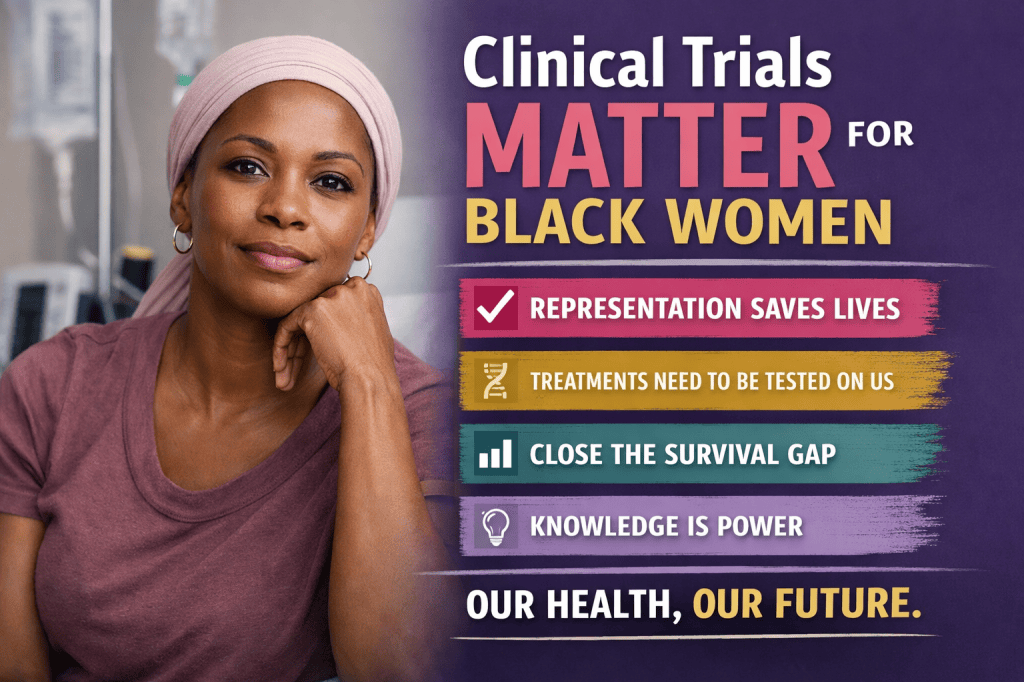
Black women are underrepresented in clinical trials. That’s a problem. When we are missing from the data, the results don’t fully reflect us. Treatments may work differently based on genetics, biology, environment, and lived experience. If Black women aren’t included, doctors are forced to guess.
Breast cancer already hits Black women harder. Higher mortality rates. More aggressive subtypes. Later diagnoses. Clinical trials help close those gaps—but only if we’re at the table.
There’s also a long history of medical mistreatment that fuels distrust. That distrust is understandable. It’s real. But modern clinical trials operate under ethical safeguards that exist precisely because of past harm. Oversight boards, patient advocates, and strict federal regulations are now part of the process.
Participation is not about being reckless. It’s about being informed and empowered.
Benefits of Participating
Clinical trials can provide access to cutting-edge treatments before they’re widely available. Participants often receive close monitoring and additional medical attention. Many trials cover the cost of the study treatment and related care.
Just as important, participation helps future Black women. It helps daughters, sisters, nieces, and friends. Representation in research saves lives. That’s not a slogan. That’s science.
How to Access Clinical Trials
Start with your doctor or oncology team. Ask directly:
“Are there any clinical trials I qualify for?”
You can also search on your own. Reputable resources include:
- ClinicalTrials.gov, a national database of ongoing studies
- Major cancer centers and teaching hospitals
- Advocacy organizations focused on breast cancer and Black women’s health
Filters allow you to search by condition, location, treatment type, and eligibility. You don’t need to live near a major research hospital to participate. Some trials are local. Some are virtual. Some only require periodic visits.
If transportation, time, or cost is a concern, say that upfront. Many trials offer support services.
The Bottom Line
Clinical trials are not a last resort. They are a vital part of progress. Black women deserve treatments that are tested with us in mind, not assumed to work for us later.
Knowledge is power. Participation is a choice. Representation is survival.
This is about agency. This is about equity. This is about us being counted because our lives count.





Leave a Reply