Breast cancer treatment doesn’t always end with surgery.
For many women, especially Black women, there’s another critical phase that follows.
It’s called adjuvant therapy.
Understanding it matters.
Because this step can lower recurrence risk and save lives.
Let’s break it down plainly.
What Is Adjuvant Therapy?
Adjuvant therapy is additional cancer treatment given after the primary treatment, usually surgery.
The goal is simple:
to destroy any cancer cells that may still be hiding in the body—even when scans look clear.
These leftover cells are often microscopic.
You can’t see them.
But they can cause cancer to come back later.
Adjuvant therapy is insurance.
Not punishment.
Not overkill.
Who Needs Adjuvant Therapy?
Not everyone.
But many do.
Your care team looks at several factors, including:
- Tumor size
- Cancer stage
- Lymph node involvement
- Hormone receptor status (ER, PR, HER2)
- Tumor grade
- Your age and overall health
Black women are more likely to be diagnosed at later stages and more likely to have aggressive subtypes, including triple-negative breast cancer.
That reality alone means adjuvant therapy is often recommended for us.
Needing adjuvant therapy does not mean your surgery failed.
It means your doctors are being thorough.
How Is Adjuvant Therapy Administered?
Adjuvant therapy isn’t one thing.
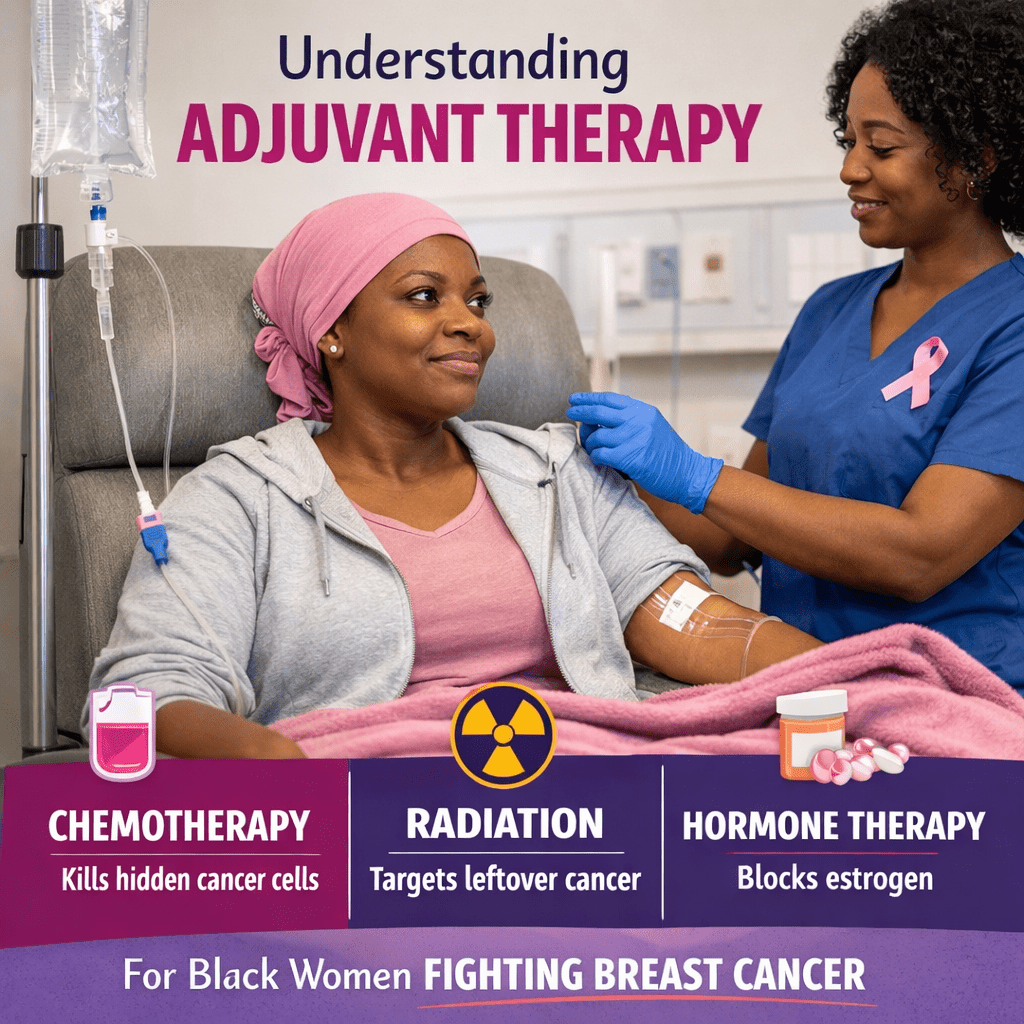
It can include one or more of the following:
Chemotherapy
Given through an IV or pills.
Targets fast-growing cancer cells throughout the body.
Radiation Therapy
Uses high-energy rays to kill cancer cells in a specific area, often the breast or chest wall.
Hormone (Endocrine) Therapy
For hormone-positive cancers.
Taken as a daily pill for several years to block estrogen.
Targeted Therapy
Designed to attack specific cancer markers, such as HER2.
Your treatment plan is personal.
There is no one-size-fits-all path.
Why Is Adjuvant Therapy Recommended?
Because breast cancer recurrence is real.
And for Black women, the risk can be higher.
Adjuvant therapy helps:
- Reduce the chance of cancer returning
- Lower the risk of metastasis
- Improve long-term survival
This isn’t about fear.
It’s about facts.
When doctors recommend adjuvant therapy, they’re weighing benefit versus risk—carefully.
When Does Adjuvant Therapy Happen?
Usually, after surgery, the body has healed enough to tolerate treatment.
Timing varies based on:
- Type of therapy
- Surgical recovery
- Individual health factors
Some treatments last weeks.
Others last months.
Hormone therapy can last years.
Length doesn’t equal severity.
It equals strategy.
Why This Conversation Matters for Black Women
Black women are often:
- Under-informed
- Under-supported
- Over-burdened with decisions
Too many of us are told what to do without being told why.
You deserve clarity.
You deserve to ask questions.
You deserve to understand every step of your care.
Adjuvant therapy is not a sign of weakness.
It is an act of protection.
Final Thoughts
If adjuvant therapy is part of your breast cancer journey, know this:
You didn’t do anything wrong.
Your body is not failing you.
You are taking steps to protect your future.
Knowledge is power.
And informed women make stronger decisions.
At Melanin & Pink Ribbons, we believe Black women deserve both truth and tenderness—especially when it comes to breast cancer



 Melanin & Pink Ribbons
Leave a comment